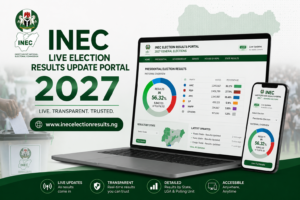
The 2027 Nigerian General Elections are fast approaching, and millions of Nigerians are eager to know how they can access live and verified election results as they are announced. The Independent National Electoral Commission (INEC) has set up a dedicated online platform to ensure transparency and accountability in the electoral process — the INEC Election Results Viewing Portal, accessible at www.inecelectionresults.ng.
INEC Live Election Results Update Portal 2027 Elections
In this comprehensive guide, we explain everything you need to know about the INEC Result Portal — what it is, how it works, what information it provides, and how Nigerian voters and observers can use it to check election results for the Presidential, Gubernatorial, and Senatorial elections in 2027.
What is the INEC Result Portal?
The INEC Result Portal — officially known as the INEC Result Viewing Portal (IReV) — is an online platform created by the Independent National Electoral Commission of Nigeria to allow the public to view scanned copies of election result sheets as they are uploaded from polling units across the country.
Launched in response to growing demand for electoral transparency, the IReV portal allows citizens, civil society organisations, political parties, journalists, and international observers to access election results directly — without waiting for official announcements or relying solely on media reports.
The portal hosts images of Form EC8A, the official polling unit result sheet that presiding officers fill out at each polling unit immediately after voting ends and counting is completed. This means that for every polling unit across Nigeria’s 36 states and the FCT, a result sheet should ideally be uploaded to the portal in real time.
Will the INEC Portal Be Used for the 2027 Presidential, Gubernatorial, and Senatorial Elections?
Yes. INEC has affirmed its commitment to deploying the IReV portal for all elections in the 2027 electoral cycle. This includes:
The 2027 Presidential Election
Gubernatorial Elections (elections for state governors)
Senatorial Elections (elections for Senate seats)
House of Representatives Elections
State House of Assembly Elections
The use of the IReV portal aligns with INEC’s broader mandate under the Electoral Act 2022, which requires that polling unit results be transmitted electronically to a central collation system. The 2023 elections were the first major test of this system, and the lessons learned are expected to inform a significantly improved implementation in 2027.
Official INEC Result Website
The official INEC election results website is:
www.inecelectionresults.ng
This is the only government-authorised platform where Nigerians can view authentic polling unit results. Citizens are advised to disregard results posted on unofficial websites, social media pages, or third-party platforms, as these could be manipulated or inaccurate.
Additionally, INEC’s main website at
www.inecnigeria.org also contains supplementary information about elections, voter registration, and electoral guidelines.
How to Check INEC Presidential Election Results Online
Checking INEC election results online is a simple process. Follow these steps to view results from any polling unit in Nigeria:
Step 1: Open your web browser and navigate to www.inecelectionresults.ng
Step 2: Select the type of election you want to view results for — Presidential, Governorship, Senatorial, or House of Representatives.
Step 3: Select your State from the dropdown menu.
Step 4: Select your Local Government Area (LGA).
Step 5: Select your Ward.
Step 6: Select your Polling Unit from the list.
Step 7: The uploaded result sheet (Form EC8A) for that polling unit will be displayed on your screen.
Note: The portal is optimised for desktop and mobile devices, so you can easily check results from your smartphone without needing to install any app. An active internet connection is required.
How the INEC IReV Portal Works
The IReV (INEC Result Viewing) Portal is powered by a backend digital infrastructure that connects Returning Officers, Presiding Officers, and INEC’s central data systems. Here is how the process works from the polling unit to the portal:
1. Voting and Counting at the Polling Unit
After accreditation and voting close, INEC officials count the ballots at the polling unit in the presence of party agents, observers, and members of the public. The results are recorded on Form EC8A.
2. Digital Upload of Result Sheets
The Presiding Officer uses a dedicated INEC-issued device (BVAS — Bimodal Voter Accreditation System) to photograph the completed Form EC8A and upload it directly to the IReV portal. This upload is expected to happen in real time or as soon as network connectivity is available.
3. Result Aggregation at Collation Centres
Results from individual polling units are collated at the Ward, LGA, and State levels before a final declaration is made. The portal, however, shows results at the polling unit level, giving the public raw, unmanipulated data before the collation process is complete.
4. Public Access via the Portal
Citizens can log on to www.inecelectionresults.ng and view any polling unit’s result by drilling down through the state, LGA, ward, and polling unit hierarchy. No login is required to view the results — the portal is publicly accessible.
Benefits of the INEC Result Viewing Portal
The INEC IReV portal offers a wide range of benefits for Nigerian democracy and electoral integrity:
Transparency: By making polling unit result sheets publicly available, INEC eliminates the opacity that has historically surrounded election results collation in Nigeria.
Real-Time Access: Citizens no longer have to rely solely on media announcements. They can independently verify results from their own polling units.
Reduced Manipulation: When results are uploaded at the source, it becomes much harder to alter figures during collation, as any discrepancy between the uploaded sheet and the collated figure is immediately visible to the public.
Voter Empowerment: Ordinary voters, party agents, and civil society groups can now serve as watchdogs of the electoral process without needing insider access.
International Credibility: The portal strengthens Nigeria’s credibility in the eyes of international election observers and donor organisations, demonstrating a commitment to democratic best practices.
Legal Evidence: Uploaded result sheets can serve as legal evidence in election tribunals where disputed results need to be verified.
Can Results Be Viewed in Real Time?
Yes — ideally, election results on the INEC portal are updated in real time as each polling unit result is uploaded. However, the actual speed of upload depends on several practical factors:
Internet connectivity in the polling unit’s location (rural areas may experience delays)
The availability and functionality of the BVAS device
Network congestion during peak upload periods (election day sees millions of data points being uploaded simultaneously)
Training and compliance of the Presiding Officer
In the 2023 elections, many polling unit results were uploaded within hours of the close of voting, while some took longer due to connectivity issues. INEC has committed to addressing these challenges ahead of 2027 through infrastructure upgrades and staff training.
Information Available on the INEC Portal
When you visit www.inecelectionresults.ng, you can access the following information:
Scanned Result Sheets (Form EC8A): The officially completed polling unit result form, showing votes cast for each candidate and party.
Voter Accreditation Data: The number of registered voters, accredited voters, and valid votes cast at each polling unit.
Rejected Ballots: Details of rejected or invalid votes at the polling unit level.
Party-by-Party Breakdown: Votes received by each political party and their candidates at the polling unit.
Election Type Filter: The ability to filter by Presidential, Gubernatorial, Senatorial, or House of Representatives elections.
Geographic Hierarchy: Results filtered by State, LGA, Ward, and Polling Unit for granular access.
Upload Timestamps: Information on when each result sheet was uploaded, providing a trail of the collation timeline.
Frequently Asked Questions (FAQs)
Q1: Is the INEC election result portal free to use?
Yes. The INEC IReV portal is completely free. Any Nigerian with internet access can visit www.inecelectionresults.ng without registering or paying any fee.
Q2: Do I need to create an account to check results?
No. The portal is a public-facing platform. You do not need to create an account or log in to view election result sheets. Simply visit the website and navigate to your desired polling unit.
Q3: What is Form EC8A?
Form EC8A is the official INEC polling unit result sheet. It is filled out by the Presiding Officer at the end of counting and is countersigned by party agents present at the polling unit. It records the number of accredited voters, total votes cast, votes per party, and rejected ballots.
Q4: What is the difference between IReV and the collation system?
IReV (INEC Result Viewing Portal) displays scanned result sheets at the polling unit level. The collation system, on the other hand, involves adding up results from multiple polling units at Ward, LGA, and State levels. While IReV is publicly visible, the collation is done by INEC officials and Returning Officers.
Q5: Can results on the portal be altered?
INEC has designed the IReV portal with security features to prevent post-upload tampering. However, the portal only displays what was uploaded by the Presiding Officer, so the integrity of the results ultimately depends on the accuracy and honesty of the official who completed the form.
Q6: What happens if results are not uploaded to the portal?
If a polling unit result is missing from the portal, it could indicate a technical failure, network outage, or potential malfeasance. Citizens, party agents, and civil society organisations are encouraged to report missing results to INEC or election observers for follow-up.
Q7: Can I use the portal result to challenge election outcomes?
Yes. The scanned Form EC8A available on the IReV portal can be used as evidence before election tribunals. Many legal disputes in the 2023 elections referenced IReV uploads as evidence of discrepancies between polling unit results and what was declared at collation.
Q8: Is there a mobile app for the INEC result portal?
As of the time of writing, INEC does not have a dedicated mobile application for the result viewing portal. However, the website is mobile-responsive and can be easily accessed from Android and iOS smartphones via any modern web browser.
The INEC Live Election Results Update Portal at www.inecelectionresults.ng represents a significant stride forward in Nigeria’s democratic journey. By making polling unit result sheets publicly accessible in real time, INEC is strengthening accountability, discouraging result manipulation, and empowering ordinary citizens to be active participants in safeguarding their votes.
As the 2027 General Elections approach, Nigerians are encouraged to familiarise themselves with the portal, understand how to navigate it, and use it to verify results from their polling units. An informed electorate is the strongest defence against electoral fraud.
Bookmark www.inecelectionresults.ng today and share this guide with fellow Nigerians so they too can hold their electoral process accountable.
Recruitmentstartup.com.ng is NOT the official page. This is only a one-page summarized information page. While we try to keep the information current and correct, be aware that information may change at any time without notice. Please always refer to the official website of the host/official page for complete and updated information.
Recruitment Startup is founded and managed by Otty Emmanuel, a recruitment and career content specialist based in Nigeria. With a strong background in digital publishing and a passion for youth empowerment, Otty created this platform to bridge the information gap between African job seekers and available opportunities.
Otty has spent years researching, curating, and publishing recruitment news, government job announcements, and career development resources. He is committed to accuracy, timeliness, and transparency — ensuring every listing published on this platform is verified before going live.