How to Avoid Recruitment Scams: The Ultimate Guide to Protecting Your Career and Personal Information
Falling victim to a recruitment scam can cost you money, your identity, and your peace of mind. Learn exactly how to spot, avoid, and report fake job offers with this comprehensive, expert-backed guide.
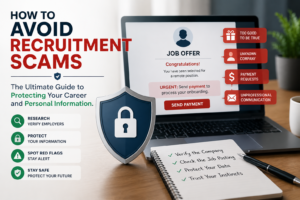
How to Avoid Recruitment Scams
Every year, millions of job seekers around the world lose money, personal data, and precious time to recruitment scams. According to the Federal Trade Commission (FTC), job and employment scams consistently rank among the top fraud categories reported globally, with losses running into hundreds of millions of dollars annually. In Nigeria and across Africa, recruitment fraud has become so rampant that it threatens not just individual financial security, but also public confidence in legitimate hiring processes.
Whether you are a fresh graduate sending out your first applications, a seasoned professional exploring new opportunities, or someone desperately seeking work after a layoff, you are a potential target. Scammers are sophisticated, patient, and increasingly convincing. They impersonate real companies, create professional-looking websites, and craft job offers that seem almost too good to be true — because they are.
This guide is your comprehensive resource for understanding how recruitment scams work, recognizing the red flags before it is too late, and taking decisive steps to protect yourself. By the time you finish reading, you will be equipped with the knowledge and tools to navigate your job search safely and confidently.
What Are Recruitment Scams?
Recruitment scams — also known as employment scams or fake job offer scams — are fraudulent schemes in which bad actors pose as employers, recruiters, or staffing agencies to deceive job seekers. Their goals typically fall into one or more of the following categories:
- Financial theft: Tricking you into paying fees for training materials, background checks, uniforms, or visa processing.
- Identity theft: Collecting sensitive personal information such as your National Identification Number (NIN), Bank Verification Number (BVN), passport details, or bank account information.
- Advance-fee fraud: Promising a high-paying job or relocation package, but requiring an upfront “processing fee” that disappears along with the scammer.
- Money laundering: Using unwitting victims as money mules by asking them to receive and transfer funds.
These scams can occur at any stage of the job search — through job boards, social media, email, WhatsApp, phone calls, or even in-person “interviews.”
Common Types of Recruitment Scams You Should Know
Understanding the various forms recruitment fraud takes is the first step in protecting yourself. Here are the most prevalent types:
1. Fake Job Postings
Scammers post convincing job advertisements on popular platforms like LinkedIn, Indeed, Jobberman, and even government job portals. These listings often feature well-known company names, attractive salaries, and minimal qualification requirements to cast a wide net. Once you apply, the “recruiter” contacts you, expresses enthusiastic interest, and moves quickly to extract fees or personal data.
2. Unsolicited Job Offers
If you receive an email, SMS, or WhatsApp message from a stranger offering you a job you never applied for — especially one promising unusually high pay for little effort — this is almost certainly a scam. Legitimate companies do not hire people out of the blue without any prior interaction or application process.
3. Work-From-Home Scams
The explosion of remote work since 2020 has given scammers a fertile new territory. Fake remote jobs — particularly “data entry,” “reshipping,” “online surveys,” or “virtual assistant” roles — are frequently used to either extract upfront payments or recruit unwitting money mules.
4. Impersonation Scams
In this type of fraud, scammers create fake email addresses, websites, or social media profiles that closely mimic legitimate companies. They may use a real company’s logo, mission statement, and even employee names to appear authentic. A careful look at the email domain or website URL often reveals the deception.
5. Overseas/International Job Scams
These scams promise high-paying jobs abroad — often in the UK, USA, Canada, or the Middle East. Victims are asked to pay for visa processing, travel, or “administrative” fees. After payment, the scammer disappears, and no job ever materializes. In more dangerous variants, victims are trafficked to foreign countries under false pretenses.
6. Fake Recruitment Agencies
Some fraudsters set up entirely fictitious staffing agencies with professional-looking offices, websites, and business cards. They charge registration fees and processing costs while never delivering genuine employment opportunities.
10 Warning Signs of a Recruitment Scam
Scams can be highly convincing, but they almost always leave tell-tale signs. Train yourself to recognize these red flags:
1. The Salary Is Unrealistically High
If a job offer promises an extraordinary salary for minimal qualifications or effort — say, ₦500,000 per month for a clerical role or $5,000 weekly for data entry — treat it with extreme skepticism. If it sounds too good to be true, it almost certainly is.
2. You Are Asked to Pay Money
This is perhaps the single biggest red flag of all: legitimate employers never ask job candidates to pay money. Any request for payment — whether for a background check, training materials, ID cards, uniforms, or “administrative processing” — is a hallmark of fraud.
3. The Hiring Process Is Suspiciously Fast
Genuine recruitment processes take time: applications, screening, interviews, reference checks, and offers. If someone offers you a job after a brief WhatsApp chat or a five-minute phone call, without any formal interview or verification of your qualifications, something is seriously wrong.
4. Communication Is Unprofessional
Look out for emails riddled with grammatical errors, inconsistent formatting, or generic greetings like “Dear Applicant.” Recruiters from reputable companies communicate professionally. Also be wary of recruiters who use personal email addresses (e.g., Gmail or Yahoo) rather than official company domains.
5. They Request Sensitive Personal Information Early
There is no legitimate reason why an employer needs your BVN, full bank details, passport scan, or NIN before you have been formally interviewed and offered the job. Sharing this information prematurely puts you at serious risk of identity theft.
6. The Job Description Is Vague or Inconsistent
Scam job postings are often deliberately vague, with little detail about actual responsibilities, required experience, or the company’s operations. If a “job description” reads more like a general advertisement than a specific role, investigate further before engaging.
7. The Interview Is Conducted Exclusively via Text or Chat
While video interviews have become normal, a reputable employer will rarely conduct an entire hiring process via WhatsApp messages or SMS. Be especially suspicious if there is no video call, no formal written offer letter, and no verifiable contact information.
8. The Company Cannot Be Independently Verified
Before engaging with any recruiter, search the company’s name online. Look for an official website, registered address, verifiable phone number, and a presence on professional networks. If you cannot find any credible information about the organization, that is a serious warning sign.
9. There Is Pressure to Decide Quickly
Scammers often create a sense of urgency — “The position must be filled by Friday,” or “You must make payment today or lose the opportunity.” Legitimate employers understand that candidates need time to evaluate offers. High-pressure tactics are a classic manipulation tool.
10. The Job Requires You to Handle or Transfer Money
Be extremely cautious if a job involves receiving payments into your personal bank account and forwarding them elsewhere. This is the hallmark of a money mule scheme, which is not only dangerous but can make you criminally liable.
How to Verify a Legitimate Job Offer
If you are uncertain about a job opportunity, take these concrete steps to verify its legitimacy before proceeding:
Research the Company Independently: Do not rely solely on information provided by the recruiter. Search for the company’s official website, verify its registration with the relevant regulatory body (e.g., the Corporate Affairs Commission in Nigeria), and read independent reviews on platforms like Glassdoor.
Contact the Company Directly: Use contact details you find on the company’s official website — not those provided in the suspicious email or message — to confirm whether the job opening is genuine and whether the recruiter is a real employee.
Verify the Job Listing on Official Platforms: Check if the vacancy is advertised on the company’s own website or on reputable job boards. If a vacancy only exists in a WhatsApp message or an obscure website, be very wary.
Check the Email Domain: A recruiter from a legitimate company will contact you from an official company email (e.g., hr@company.com), not from a generic personal email address. A slight variation in the domain name (e.g., “companyy.com” instead of “company.com”) is a major red flag.
Consult Trusted Networks: Reach out to friends, family, or professional contacts who may have experience with the company. LinkedIn is a valuable tool for verifying whether the recruiter actually works for the organization they claim to represent.
Never Pay Any Fee: Reiterate to yourself — no legitimate employer charges you to apply for or accept a job. Any fee request, no matter how convincingly explained, should trigger an immediate halt to proceedings.
What to Do If You Suspect a Recruitment Scam
If you believe you have encountered a recruitment scam, take the following steps immediately:
Stop All Communication: Do not respond further to the suspected scammer. Do not send any more money, documents, or personal information.
Do Not Transfer Any Money: If you have already been asked to transfer funds you received into your account, stop immediately. Even if the money “came from someone else,” you may be participating in a crime.
Report the Scam: In Nigeria, report recruitment scams to the Economic and Financial Crimes Commission (EFCC), the Nigerian Communications Commission (NCC), or the relevant law enforcement agency. Internationally, report to the FTC (USA), Action Fraud (UK), or your country’s cybercrime authority.
Alert the Impersonated Company: If the scammer was posing as a real organization, notify that company’s HR or communications team so they can warn others and take appropriate action.
Report to the Job Platform: If the fraudulent listing appeared on a job board like LinkedIn, Indeed, or Jobberman, report it so the post can be removed and the account flagged.
Notify Your Bank: If you shared your banking details or transferred money, contact your bank immediately to freeze your account, reverse any transactions if possible, and prevent further unauthorized access.
Document Everything: Keep records of all communications — emails, messages, screenshots, and any documents provided. This evidence will be valuable for law enforcement.
How to Protect Yourself Going Forward
Prevention is always better than cure. Integrate these best practices into your job search strategy:
- Use reputable platforms. Stick to well-known, verified job boards and apply directly through company websites wherever possible.
- Guard your personal information. Never share sensitive details (BVN, NIN, passport number) until you have verified the employer’s legitimacy and received a formal, written offer.
- Keep your resume data minimal. On public job platforms, avoid listing your full address, date of birth, or financial information. These details are not needed at the application stage.
- Enable two-factor authentication on your email and professional networking accounts to prevent unauthorized access.
- Trust your instincts. If something feels off — if the process feels rushed, the recruiter seems evasive, or the offer seems implausible — listen to that instinct and investigate before proceeding.
- Educate those around you. Share information about recruitment fraud with family members, particularly elderly parents or younger siblings who may be less familiar with online scams.
Special Note for Recent Graduates and Vulnerable Job Seekers
Recent graduates and those experiencing unemployment are disproportionately targeted by recruitment scammers because desperation can cloud judgment. If you are in this position, remember: your eagerness to find work is understandable and valid, but it should never come at the cost of your safety.
Take your time with every application. Build your professional network through verified channels. Seek career guidance from your institution’s placement office, professional associations, or trusted mentors. The right job will come — and when it does, you will not be asked to pay for it.
Frequently Asked Questions (FAQs)
Q: Can a legitimate company ask for my bank details before employment begins?
A: Only after a verified, formal job offer is in place — and only for the purpose of setting up your salary payments. Even then, be cautious and confirm the request through the company’s official HR channels.
Q: Are all work-from-home jobs scams?
A: Absolutely not. Remote work is a legitimate and growing employment model. However, work-from-home scams are especially common, so apply the same verification standards you would to any other job opportunity.
Q: What if I already paid money to a scammer?
A: Report it to law enforcement and your bank immediately. While recovering lost funds can be difficult, acting quickly improves your chances. Do not pay any further “recovery fees” promised by third parties — these are almost always secondary scams.
Q: How can I tell if a LinkedIn job posting is fake?
A: Check whether the posting company’s LinkedIn page is verified (look for the blue checkmark), review the recruiter’s profile history and connections, and cross-check the vacancy on the company’s official website.
Recommended Also:
- Best Jobs Websites in Nigeria
- 30 Highest Paying Federal Government Jobs in Nigeria 2026
- 15 Common Interview Questions in Nigeria
- Salary of Nigerian Doctors 2026
- WAEC Recruitment 2026
Conclusion: Stay Informed, Stay Safe
Recruitment scams are a growing threat, but they are not undefeatable. Armed with the right knowledge, a healthy dose of skepticism, and a commitment to verifying every opportunity before you act on it, you can navigate your job search safely and successfully.
The most powerful weapon against recruitment fraud is awareness. Share this article with your network. Talk to your friends and family about the warning signs. Report suspicious job offers whenever you encounter them. Together, we can reduce the impact of recruitment scams and create a safer job market for everyone.
Your dream job is out there — and you deserve to find it without falling prey to those who would exploit your ambition. Stay alert, stay informed, and never pay to work.
Did you find this article helpful? Share it on social media and help protect someone else from recruitment fraud. Have a question or experience to share? Drop a comment below — we read every one.
Disclaimer:
Recruitmentstartup.com.ng is NOT the official recruitment page. Recruitmentstartup.com.ng is a trusted job aggregation portal for Jobs and opportunities in Nigeria and Africa . While we try to keep the information current and correct, be aware that information may change at any time without notice. Please always refer to the official website of the host/official page for complete and updated information. Leave a comment behind let us know how we can help you. We welcome your feedback.Tags: employment scams, fake job offers, how to spot a fake recruiter, job scam warning signs, recruitment fraud
