CV vs Resume: Differences, Examples & Expert Tips
You’ve found the perfect job. You’re ready to apply. Then the listing says “Submit your CV” — and suddenly you’re wondering: wait, do I have a CV? Isn’t that the same as a resume? The short answer is: not exactly. The long answer is what this guide is all about.
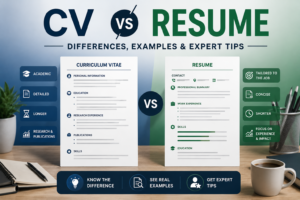
CV vs Resume Differences, Examples & Expert Tips
In this comprehensive guide, we’ll walk you through exactly what each document is, how they differ, which countries and industries use each, real-world examples, and expert tips sourced from hiring professionals so you can put your best foot forward — every time.
1. What Is a CV (Curriculum Vitae)?
The term curriculum vitae comes from Latin and translates literally to “course of life.” That etymology is not accidental — a CV is meant to be a comprehensive, living record of your entire professional and academic journey.
Unlike a resume, a CV is not tailored to a single job. It is a master document that grows with you over the course of your career. Every time you publish a paper, deliver a conference talk, earn a certification, or take on a new academic appointment, it goes into the CV. A senior academic or researcher might have a CV stretching 10, 15, or even 20 pages.
What a CV Typically Includes
- Personal information — full name, professional email, phone, LinkedIn, academic website or ORCID
- Education — listed in reverse chronological order, including degrees, institutions, dates, dissertation titles, and advisors
- Research experience — detailed descriptions of projects, methodologies, and outcomes
- Publications — journal articles, book chapters, conference papers, and preprints
- Presentations & conference talks — invited, contributed, and poster sessions
- Grants, awards, and fellowships
- Teaching experience — courses taught, institutions, and roles
- Professional affiliations and service — editorial boards, committees, peer review work
- Skills — technical, software, laboratory, language proficiencies
- References — often included at the end, especially for academic roles
In the United States and Canada, a CV is primarily used for academic, scientific, and medical positions. In the UK, Europe, Africa, Asia, and most of the rest of the world, however, the word “CV” is used as a general term for what Americans would call a resume.
2. What Is a Resume?
The word resume (from the French résumé, meaning “summary”) is exactly what it sounds like: a concise, curated summary of your professional background, specifically tailored to a single job application.
Where a CV is comprehensive and cumulative, a resume is strategic and selective. You don’t include everything you’ve ever done — you include only what’s most relevant to the position you’re applying for. You are telling a story with a specific audience in mind: the hiring manager for this role at this company.
What a Resume Typically Includes
- Contact information — name, phone, professional email, LinkedIn URL, city (not full address)
- Professional summary or objective — 2–4 sentence snapshot of your value proposition
- Work experience — in reverse chronological order; focused on achievements, not just duties
- Education — degrees, institutions, graduation years
- Skills — a curated list of hard and soft skills relevant to the target role
- Optional sections — certifications, projects, volunteer work, languages, awards
Every single line on your resume should pass this test: “Does this make a hiring manager more likely to want to interview me for THIS specific job?” If the answer is no — cut it.
3. CV vs Resume: The Key Differences at a Glance
Let’s cut to the chase. Here is every major structural, contextual, and stylistic difference between the two documents, laid out side by side.
Pages for a standard resume
Pages for an academic CV
Avg. time a recruiter scans a resume
Resumes filtered by ATS before human review
| Factor | CV (Curriculum Vitae) | Resume |
|---|---|---|
| Length | 2+ pages; can extend to 20+ pages | Strictly 1–2 pages |
| Purpose | Comprehensive academic & career record | Targeted job application document |
| Content | Everything: publications, grants, conferences, teaching | Only what’s relevant to the specific role |
| Customization | Mostly static; updated, not rewritten | Tailored from scratch for every application |
| Used in | Academia, research, medicine, science (US/Canada); general use (UK/EU/Global) | Corporate, commercial, most US & Canadian industries |
| Format | Conservative, text-heavy, section-driven | Clean, scannable, often uses design elements |
| References | Often included directly in document | Usually listed as “available upon request” |
| Photo | Sometimes (country-dependent) | Almost never in the US/Canada (discrimination risk) |
| Objective statement | Rarely used | Professional summary is standard |
| Update frequency | Ongoing additions as career progresses | Rewritten for each job application |
4. Country-by-Country Guide: CV or Resume?
One of the most persistent sources of confusion around CVs and resumes is geography. The terminology does not mean the same thing everywhere in the world, and what’s expected in Lagos can be completely different from what’s expected in Los Angeles.
Countries Where “CV” Means a General Application Document
🇮🇪 Ireland
🇩🇪 Germany
🇫🇷 France
🇳🇬 Nigeria
🇿🇦 South Africa
🇮🇳 India
🇦🇺 Australia
🇳🇿 New Zealand
🇸🇬 Singapore
🇦🇪 UAE
🇰🇪 Kenya
In these countries, when an employer says “send us your CV,” they essentially mean what Americans would call a resume — a professional application document of 1–3 pages. The word “resume” is rarely used.
Countries Where “Resume” Is the Standard Term
🇨🇦 Canada
In the US and Canada, “resume” is the standard document for corporate job applications. A CV here refers specifically to the long-form academic document used for university positions, research roles, and medical/scientific careers.
Countries Where Both Terms Coexist
🇲🇽 Mexico
🇳🇱 Netherlands
🇸🇪 Sweden
When applying internationally, always research the local convention. If in doubt, write a concise, well-structured 2-page document and call it whatever the job listing calls for. When applying to a UK employer, call it a CV. When applying to a US company, call it a resume.
5. Which Industries Use Which Document?
Even within a single country, your industry plays a huge role in determining which document is expected. Here’s a breakdown by sector in the US/Canada context:
| Industry / Role | Document Required | Why |
|---|---|---|
| University faculty & research | CV | Publications, grants, and teaching history are essential |
| Medical doctors & surgeons | CV | Licensure, residencies, fellowships, and publications required |
| Scientific researchers | CV | Lab experience, grants, and peer-reviewed work must be listed |
| Corporate jobs (any field) | Resume | Concise, achievement-driven format preferred by recruiters |
| Technology / engineering | Resume | Skills, projects, and measurable impact are prioritized |
| Marketing & sales | Resume | Results and KPIs are the core of the document |
| Government & federal jobs (US) | Federal Resume (a hybrid) | Longer than a resume, but structured differently from a CV |
| Non-profit sector | Resume | Mission alignment + professional skills |
6. Real-World CV Example (Academic Format)
Below is a simplified example of what a CV looks like for an early-career academic researcher in the sciences. Note the emphasis on publications, grants, and institutional affiliations — none of which would appear on a standard resume.
Academic / Research
- PhD, Molecular Biology — Harvard University, 2022. Dissertation: “Epigenetic Regulation of Stress Response Pathways in Arabidopsis thaliana.” Advisor: Prof. L. Zhang.
- BSc (Hons), Biochemistry — University of Ghana, 2016. First Class Honours.
- Postdoctoral Fellow — MIT Department of Biology, 2022–Present. Investigating CRISPR-based gene regulation mechanisms in plant stress tolerance.
- Graduate Research Assistant — Harvard Biological Laboratories, 2017–2022. Led a team of 4 in exploring chromatin remodeling complexes.
- Osei-Bonsu, A., Zhang, L. et al. (2023). “Histone deacetylase activity modulates drought response in Arabidopsis.” Nature Plants, 9(4), 411–425. DOI: 10.1038/xxxxx
- Osei-Bonsu, A. (2022). “CRISPR-Cas9 efficiency enhancement via guide RNA secondary structure optimization.” Cell Reports, 38(11). DOI: 10.1016/xxxxx
- NIH Ruth L. Kirschstein NRSA Postdoctoral Fellowship (F32), 2023–2025. Grant value: $116,000.
- American Society of Plant Biologists Travel Award, 2021.
- Teaching Fellow, BIOL 203: Cell Biology — Harvard University, Spring 2019 & 2020.
- Guest Lecturer, MIT 7.28J Molecular Biology — 2023.
7. Real-World Resume Example (Corporate Format)
Now compare the CV above to this resume example for a marketing professional applying to a specific corporate role. Notice how it is concise, achievement-focused, and designed to be skimmed quickly by a recruiter.
Corporate / Marketing
Results-driven Senior Marketing Manager with 8 years of experience driving brand growth and digital acquisition for B2B SaaS companies. Proven record of scaling organic traffic by 200%+ and reducing customer acquisition costs by 35% through data-led campaign strategies.
- Senior Marketing Manager — TechFlow Inc., Atlanta GA (2021–Present)
- Grew organic search traffic 217% YoY by leading a team of 5 in an SEO content overhaul
- Reduced CAC from $420 to $274 through multi-channel attribution modelling
- Launched a referral program generating $1.2M in pipeline within 6 months
- Marketing Manager — Growbase, Remote (2018–2021)
- Managed a $600K annual marketing budget across paid search, social, and email
- Increased email open rates from 18% to 31% through segmentation and A/B testing
- MBA, Marketing Strategy — Georgia State University, 2018
- BA, Communications — Spelman College, 2015
HubSpot · Salesforce · Google Analytics 4 · Semrush · SQL (basic) · Figma · Content Strategy · Demand Generation · Account-Based Marketing (ABM)
The contrast is clear. The CV documents an entire scholarly career. The resume makes a sharp, persuasive case for one specific job opening.
8. Expert Tips from Hiring Managers
We’ve distilled the most impactful, actionable advice from talent acquisition professionals, career coaches, and senior hiring managers across industries. These tips apply whether you’re crafting a CV or a resume.
Lead with impact, not duties
Replace “Responsible for managing social media” with “Grew Instagram following from 4K to 42K in 12 months.” Quantified achievements outperform duty lists every time.
Mirror the job description language
Both ATS systems and human readers respond better when your document uses the exact terminology from the job posting. If the job says “Agile delivery,” you say “Agile delivery.”
Cut the dead weight ruthlessly
Hobbies, “References available upon request,” high school education (if you have a degree), and vague phrases like “strong communicator” — they waste valuable space and credibility.
Use clean, ATS-friendly fonts
Stick to Calibri, Garamond, Georgia, or Arial. Avoid decorative fonts, text boxes, tables, or headers/footers for key content — many ATS systems can’t parse them.
Address gaps proactively
Career gaps are common and understandable. A brief, honest note like “Career pause: full-time caregiving, 2021–2022” reads far better than a confusing timeline.
Your LinkedIn must match
Recruiters will cross-reference your LinkedIn within minutes of seeing your resume. Inconsistent dates, titles, or omissions create instant doubt. Keep both in sync.
Tips Specifically for CVs
- Keep your publications in correct citation format (APA, MLA, or Chicago depending on your field). Inconsistent formatting signals sloppiness to academic search committees.
- Always list your most significant grants and fellowships with the dollar value — this demonstrates your ability to attract funding, a critical metric in academia.
- Include your dissertation abstract or thesis title, especially if you are early-career and your research is your strongest selling point.
- Tailor your teaching philosophy or research statement separately — these are companion documents to the CV for faculty applications, not embedded within it.
9. ATS Optimization: Making Your Document Machine-Readable
Whether you are submitting a CV or a resume, there’s a very high probability it will pass through an Applicant Tracking System (ATS) before a human ever sees it. Research suggests that up to 75% of resumes are rejected by ATS software before reaching a recruiter’s inbox.
Here is how to ensure your document makes it through:
ATS Best Practices for Both CVs and Resumes
- Use a .docx or PDF format. Most modern ATS systems handle both, but always check the submission instructions. When in doubt, use .docx.
- Don’t embed important information in headers, footers, or text boxes. ATS parsers often skip these entirely, meaning your contact info could vanish.
- Use standard section headings. “Work Experience,” “Education,” and “Skills” are universally recognized. Clever alternatives like “My Journey” or “What I Bring” confuse parsers.
- Avoid columns and fancy tables. Two-column layouts that look great in Word can scramble into gibberish when parsed by an ATS.
- Include keywords naturally throughout the body. Don’t just list keywords in a skills section — weave them into your experience descriptions to satisfy semantic analysis.
- Spell out acronyms at least once. Write “Search Engine Optimization (SEO)” rather than assuming the parser knows what “SEO” means.
- Save your file with a professional name. “LaylaMensah_Resume_TechFlow.docx” is infinitely better than “FinalResumev3_UPDATED.docx.”
Run your resume or CV through a free ATS checker like Jobscan, Resume Worded, or Skillsyncer before submitting. These tools compare your document against the job description and highlight gaps in keyword alignment.
10. Common Mistakes to Avoid
Even experienced professionals make avoidable errors when preparing these documents. Here are the most frequent ones — and how to fix them.
Mistakes on Resumes
- Using one generic resume for every job. A resume that isn’t tailored is a resume that gets ignored. A recent LinkedIn study found tailored resumes are 40% more likely to earn a callback.
- Listing job duties instead of achievements. “Managed a team” tells a recruiter almost nothing. “Managed a 7-person team, reducing project delivery time by 22%” is a reason to call you.
- Including a photo in the US or Canada. This exposes employers to discrimination liability, and many will discard the resume to protect themselves before even reading it.
- Using an unprofessional email address. “partytime1987@gmail.com” will sink your application before it begins.
- Exceeding two pages without justification. Unless you are a very senior executive with 20+ years of directly relevant experience, keep it to two pages maximum.
Mistakes on CVs
- Treating the CV like a resume and trimming it to two pages. Academic hiring committees expect the full picture. Cutting your publication list is a red flag.
- Using inconsistent or incorrect citation formats. This signals a lack of scholarly precision — exactly the opposite of what academic employers want to see.
- Omitting impact metrics for grants. Always list the funding amount and awarding body. “$180,000 NSF CAREER Award” speaks far louder than “NSF grant.”
- Not including your teaching evaluations or philosophy. For faculty roles, teaching is often weighted equally with research — your CV should reflect that.
- Burying the most impressive credentials at the bottom. Lead with your strongest asset: if publications are your strength, put them near the top.
11. Frequently Asked Questions (FAQ)
What is the main difference between a CV and a resume?
A CV is a comprehensive, ongoing record of your entire academic and professional career — potentially stretching dozens of pages. A resume is a concise, 1–2 page document tailored specifically for a single job application. The key difference is scope: a CV documents everything; a resume cherry-picks only what’s most relevant to one opportunity.
When should I use a CV instead of a resume?
In the US and Canada: use a CV when applying for academic positions (faculty, research, postdoctoral), scientific roles, or medical positions that require a record of publications, grants, and teaching. Everywhere else in the world: use a CV whenever the job listing asks for one — it’s simply the local word for a professional application document.
How long should a CV be compared to a resume?
A resume should be 1–2 pages for most professionals (up to 3 for very senior roles). A CV has no strict page limit — an early-career academic’s CV might be 4–6 pages, while a full professor’s could be 20 or more. Length on a CV is not a problem; it’s expected.
Is a CV better than a resume?
Neither is objectively superior. Each document is the right tool for a specific situation. Sending a full academic CV for a corporate marketing job is just as inappropriate as sending a two-page resume to a university faculty search committee. Match the document to the context.
Can I use the same CV for every job?
For academic CVs, the document is largely consistent — you add to it rather than rewrite it. However, you may reorder sections to emphasize research vs. teaching depending on the institution. For the general-use CV (UK/EU/Global), you should still tailor it to each role, adjusting your personal statement and highlighting the most relevant experience.
Should I include a photo on my CV or resume?
In the United States and Canada, never include a photo on either document — it creates discrimination liability for employers and is widely considered unprofessional. In Germany, France, and parts of the Middle East and Asia, a professional headshot is still standard. Always follow local conventions and any specific instructions from the employer.
What should I put in a CV personal statement?
For a UK/EU-style CV, a personal statement (also called a profile or objective) is a 3–5 sentence paragraph at the top that summarizes who you are professionally, your core skills, and what you are looking for. It should be tailored to the specific role and convey your unique value proposition without generic filler phrases.
Recommended:
Final Verdict: Which Should You Use?
The answer comes down to three questions: Where are you applying? What industry is it in? What does the job listing ask for? If you’re in the US applying to a corporate role — resume. If you’re pursuing a faculty position or applying outside North America — CV. When in doubt, write a tight, well-structured document that speaks directly to the role, and call it whatever they asked for.
Whichever document you choose, the underlying principle is the same: make every word earn its place. Hiring managers and search committees are busy people reviewing hundreds of applications. Your CV or resume has one job — to make them pick up the phone and call you. With the guidance in this article, you now have everything you need to do exactly that.
Disclaimer:
Recruitmentstartup.com.ng is NOT the official recruitment page. Recruitmentstartup.com.ng is a trusted job aggregation portal for Jobs and opportunities in Nigeria and Africa . While we try to keep the information current and correct, be aware that information may change at any time without notice. Please always refer to the official website of the host/official page for complete and updated information. Leave a comment behind let us know how we can help you. We welcome your feedback.Tags: Career Advice, Curriculum Vitae, CV vs Resume, Job Application, Resume Tips
